Semua tulisan dari Ahmad Sobirin

What Is Hyperinflation?

What Is Hyperinflation?

All economies experience some level of inflation, which occurs when the average price of goods increases, as the purchasing power of that currency decreases. Usually, governments and financial institutions work together to ensure inflation occurs at a smooth and gradual rate. However, there have been many instances in history where inflation rates have accelerated at such an unprecedented degree that it caused the real value of that country’s currency to be diminished in alarming proportions. This accelerated rate of inflation is what we call hyperinflation.
What Is Hyperinflation?
In his book, “The Monetary Dynamics of Hyperinflation,” economist Philip Cagan states that hyperinflation periods begin when the price of goods and services increases by more than 50% within one month. For example, if the price of a sack of rice increases from $10 to $15 in less than 30 days, and from $15 to $22.50 by the end of the following month, we would have hyperinflation. And if this trend continues, the price for the sack of rice could rise to $114 in six months, and over $1,000 in one year.
Rarely does the rate of hyperinflation remain stagnant at 50%. In most cases, these rates accelerate so rapidly that the price of various goods and services can increase drastically within one single day or even hours. As a consequence of rising prices, consumer confidence declines and the value of the country’s currency decreases. Eventually, hyperinflation causes a ripple effect leading to company closures, increased unemployment rates, and decreased tax revenue. Well-known hyperinflation episodes occurred in Germany, Venezuela, and Zimbabwe, but many other countries experienced similar crisis, including Hungary, Yugoslavia, Greece, and many more.

Hyperinflation in Germany

One of the most famous examples of hyperinflation took place in the Weimar Republic of Germany after the First World War. Germany had borrowed massive amounts of money to fund the war effort, fully believing they would win the war and use reparations from the Allies to repay these debts. Not only did Germany not win the war, but they were required to pay billions of dollars in reparations.
Despite the debate about the causes of Germany’s hyperinflation, some commonly cited causes include the suspension of the gold standard, the war reparations, and the reckless issuance of paper money. The decision to suspend the gold standard at the beginning of the war meant that the amount of money in circulation bore no relation to the value of gold the country owned. This controversial step led to the devaluation of the German currency, which forced the Allies to demand reparations be paid in any currency other than the German paper mark. Germany responded by printing massive amounts of its own money to purchase foreign currency, causing the value of the German mark to depreciate even more.
At some points during this episode, inflation rates were increasing at a pace of more than 20% per day. German currency became so worthless that some citizens burned the paper money to keep their houses warm, as it was cheaper than buying wood.

Hyperinflation in Venezuela

Thanks to its large oil reserves, Venezuela maintained a healthy economy during the 20th century, but the 1980s oil glut followed by economic mismanagement and corruption of early 21st century gave rise to a strong socioeconomic and political crisis. The crisis started in 2010 and is now among the worst in human history. 
Inflation rates in Venezuela increased rapidly, raising from an annual rate of 69% in 2014 to 181% in 2015. The period of hyperinflation started in 2016, marked by 800% inflation by the end of the year, followed by 4,000% in 2017 and over 2,600,000% in early 2019.
In 2018, president Nicolás Maduro announced that a new currency (sovereign bolivar) would be issued in order to fight the hyperinflation, replacing the existing bolivar at a rate of 1/100,000. Thus, 100,000 bolivares became 1 sovereign bolivar. However, the efficacy of such an approach is highly questionable. Economist Steve Hanke stated that cutting zeros is “a cosmetic thing” and “means nothing unless you change economic policy.”

Hyperinflation in Zimbabwe

After the independence of the country in 1980, Zimbabwe’s economy was quite stable during its early years. However, the government of President Robert Mugabe initiated a program in 1991 called ESAP (Economic Structural Adjustment Programme) that is deemed as a major cause of Zimbabwe’s economic collapse. Along with ESAP, land reforms performed by authorities resulted in a drastic drop in food production, leading to a big financial and social crisis.
The Zimbabwe dollar (ZWN) started to present signals of instability in the late 1990s, and hyperinflationary episodes began in the early 2000s. Annual inflation rates reached 624% in 2004, 1,730% in 2006, and 231,150,888% on July 2008. Due to the lack of data provided by the country’s central bank, the rates after July were based on theoretical estimates. 
According to Professor Steve H. Hanke’s calculations, Zimbabwe’s hyperinflation reached a peak in November 2008, at an annual rate of 89.7 sextillion percent, which is equivalent to 79.6 billion percent per month, or 98% per day.
Zimbabwe was the first country to experience hyperinflation in the 21st century and recorded the second worst inflation episode in history (after Hungary). In 2008, the ZWN was officially abandoned, and foreign currencies were adopted as legal tender.

The use of cryptocurrencies

Since Bitcoin and other cryptocurrencies are not based on centralized systems, their worth cannot be determined by governmental or financial institutions. Blockchain technology ensures that the issuance of new coins follows a predefined schedule and that each unit is unique and immune to duplication. 
These are some of the reasons why cryptocurrencies are becoming increasingly popular – especially in countries that are dealing with hyperinflation, such as Venezuela. Similar occurrences can be seen in Zimbabwe, where digital currencies peer-to-peer payments have seen a dramatic rise.
In some countries, authorities are seriously studying the possibilities and risks associated with the introduction of a government-backed cryptocurrency, as a potential alternative to the traditional fiat currency system. The central bank of Sweden is among the first. Other notable examples include the central banks of Singapore, Canada, China, and the US. Although many central banks are experimenting with blockchains, these systems won’t necessarily create a new paradigm in terms of monetary policy as their cryptocurrencies are unlikely to have a limited or fixed supply like Bitcoin.

Final thoughts

Although instances of hyperinflation might seem few and far between, it’s clear that a relatively short period of political or social unrest can quickly lead to the devaluation of traditional currencies. Lower demand for the sole export of a country can also be a driving cause. Once the currency devalues, prices shoot up very quickly, eventually creating a vicious cycle. Several governments have tried to counter this problem by printing more money, but this tactic alone has proven to be useless and only served to further decrease the overall currency value. It is interesting to note that as trust in traditional currency falls, faith in cryptocurrency tends to rise. This might have powerful implications for the future of how money is viewed and dealt with globally.

What Is an ICO (Initial Coin Offering)?

What is an ICO?

An Initial Coin Offering (or ICO) is a method for teams to raise funds for a project in the cryptocurrency space. In an ICO, teams generate blockchain-based tokens to sell to early supporters. This serves as a crowdfunding phase – users receive tokens that they can use (either immediately or in the future), and the project receives money to fund development.

What Is an ICO (Initial Coin Offering)?

The practice was popularized in 2014 when it was used to fund the development of Ethereum. Since then, it has been adopted by hundreds of ventures (particularly during the 2017 boom), with varying degrees of success. While the name sounds similar to an Initial Public Offering (IPO), the two are fundamentally very different methods of acquiring funding.

IPOs usually apply to established businesses that sell partial ownership shares in their company as a way to raise funds. In contrast, ICOs are used as a fundraising mechanism that allows companies to raise funds for their project in very early stages. When ICO investors purchase tokens, they are not buying any ownership in the company.

ICOs can be a viable alternative to traditional funding for tech startups. Often, new entrants struggle to secure capital without an already functional product. In the blockchain space, established firms rarely invest in projects on the merits of a white paper. What’s more, a lack of cryptocurrency regulation deters many from considering blockchain startups.

The practice isn’t just used by new startups, though. Established enterprises sometimes choose to launch a reverse ICO, which is functionally very similar to a regular ICO. In this case, a business already has a product or service and issues a token to decentralize its ecosystem. Alternatively, they might host an ICO to include a broader range of investors and raise capital for a new blockchain-based product.

ICOs vs. IEOs (Initial Exchange Offerings)

Initial Coin Offerings and Initial Exchange Offerings are similar in many ways. The key difference is that an IEO is not hosted solely by the project’s team, but alongside a cryptocurrency exchange.

The exchange partners with the team to allow its users to buy tokens directly on its platform. This can be beneficial to all parties involved. When a reputable exchange supports an IEO, users can expect the project to have been rigorously audited. The team behind the IEO benefits from increased exposure, and the exchange stands to gain from the project’s success.

ICOs vs. STOs (Security Token Offerings)

Security Token Offerings were once branded the “new ICOs.” From a technological standpoint, they’re identical – tokens are created and distributed in the same manner. On the legal side, however, they’re completely different.

Due to some legal ambiguity, there is no consensus on how regulators should qualify ICOs (discussed in more detail below). As a result, the industry has yet to see any meaningful regulation.

Some companies decide to take the STO route as a way to offer equity in the form of tokens. Also, this could help them steer clear of any uncertainty. The issuer registers their offering as a securities offering with the relevant government body, which subjects them to the same treatment as traditional securities.

How does an ICO work?

An ICO can take many forms. Sometimes, the team hosting it will have a functional blockchain that they’ll continue to develop in the coming months and years. In this case, users can buy tokens that are sent to their addresses on the chain.

Alternatively, the blockchain might not have launched, in which case the tokens will be issued on an established one (such as Ethereum). Once the new chain is live, holders can swap their tokens for fresh ones issued on top of it.

The most common practice, however, is to issue tokens on a smart-contract-capable chain. Again, this is done predominantly on Ethereum – many applications use the ERC-20 token standard. Though not all originate from ICOs, it’s estimated that there are upwards of 200,000 different Ethereum tokens today.

Besides Ethereum, there are other other chains that can be used – Waves, NEO, NEM, or Stellar are some popular examples. Given how flexible these protocols are, many organizations make no plans to migrate away but instead opt to build on existing foundations. This approach allows them to tap into the network effects of an established ecosystem and gives developers access to tools that have already been tried and tested.

An ICO is announced ahead of time and specifies rules for how it will be run. It might outline a timeframe it will operate for, implement a hard cap for the number of tokens to be sold, or combine both. There might also be a whitelist that participants must sign up to beforehand.

Users then send funds to a specified address – generally, Bitcoin and Ethereum are accepted due to their popularity. Buyers either provide a new address to receive tokens, or tokens are automatically sent to the address that the payment was made from.

Who can launch an ICO?

The technology to create and distribute tokens is widely accessible. But in practice, there are many legal considerations to take into account before holding an ICO.

Overall, the cryptocurrency space is lacking in regulatory guidelines, and some crucial questions are yet to be answered. Some countries prohibit launching ICOs outright, but even the most crypto-friendly jurisdictions have yet to deliver clear legislation. It’s therefore imperative that you understand your own country’s laws before considering an ICO.

What are the regulations surrounding ICOs?

It’s difficult to give a one-size-fits-all answer because there are so many variables to consider. Regulations vary from jurisdiction to jurisdiction, and each project likely has its own nuances that may affect how government entities view it.

It should be noted that the absence of regulation in some places is not a free pass to crowdfund a project via an ICO. So it’s important to seek professional legal advice before choosing this form of crowdfunding.

On a number of occasions, regulators have sanctioned teams that raised funds in what they later deemed to be securities offerings. If authorities find a token to be a security, the issuer must comply with rigorous measures that apply to traditional assets in this class. On this front, the US’s Securities and Exchange Commission (SEC) has provided some good insights.

In general, the development of regulation is slow in the blockchain space, particularly as the tech outpaces the slow-turning wheels of the legal system. Still, numerous government entities have been discussing the implementation of a more transparent framework for blockchain technology and cryptocurrencies.

Though many blockchain enthusiasts are wary of possible government overreach (which might hamper development), most of them recognize the need for investor protection. Unlike traditional financial classes, the ability for anyone around the globe to participate presents some significant challenges.

What are the risks with ICOs?

The prospect of a new token granting huge returns is an appealing one. But not all coins are created equal. As with any cryptocurrency investment, there are no guarantees that you’ll have a positive return on investment (ROI).

It’s difficult to determine whether a project is viable, as there are many factors to assess. Prospective investors should perform due diligence and conduct extensive research into tokens they’re considering. This process should include a thorough fundamental analysis. Below is a list of some questions to ask, but it is by no means exhaustive:

  • Is the concept viable? What problem does it solve?
  • How is the supply allocated?
  • Does the project need a blockchain/token, or can it be done without one?
  • Is the team reputable? Do they have the skills to bring the project to life?

The most important rule is never to invest more than you can afford to lose. The cryptocurrency markets are incredibly volatile, and there’s a major risk that your holdings will plummet in value.

Closing thoughts

Initial Coin Offerings have been tremendously effective as a means for projects in their early stages to acquire funding. Following the success of Ethereum’s Initial Coin Offering in 2014, many organizations were able to acquire capital to develop new protocols and ecosystems.

Buyers should, however, be conscious of what they’re investing in. There are no guaranteed returns. Given the nascency of the cryptocurrency space, such investments are highly risky, and there’s little by way of protection if the project fails to deliver a viable product.

What Is Fiat Currency?

What is Fiat Currency?

Simply put, fiat currency is legal tender that derives its value from its issuing government rather than a physical good or commodity. The strength of the government that establishes the value of fiat currency is key in this type of money. Most countries around the world use the fiat currency system to purchase goods and services, invest, and save. Fiat currency replaced the gold standard and other commodity-based systems in establishing the value of legal tender.

The Rise of Fiat Currency

Fiat currency originated centuries ago in China. The Szechuan province began issuing paper money during the 11th century. At first, it could be exchanged for silk, gold, or silver. But eventually, Kublai Khan came into power and established a fiat currency system during the 13th century. Historians claim this money was instrumental in the downfall of the Mongol Empire, with excessive spending and hyperinflation at the root of its decline.
Fiat money was also used in Europe during the 17th century, being adopted by Spain, Sweden, and the Netherlands. The system was a failure in Sweden and the government eventually abandoned it for the silver standard. Over the next two centuries, New France in Canada, the American Colonies, and then the U.S. Federal Government also experimented with fiat money with mixed results.
By the 20th century, the U.S. was back to using commodity-based currency on a somewhat limited basis. In 1933, the government ended the practice of exchanging paper money for gold. By 1972, under President Nixon, the U.S. abandoned the gold standard altogether, finalizing its demise on an international scale, switching to the fiat currency system. This led to the use of fiat currency around the globe.

Fiat Currency vs. The Gold Standard

The gold standard system permitted the conversion of paper bills to gold. In fact, all paper money was backed by a finite amount of gold that was held by the government. Under a commodity-based currency system, governments and banks could only introduce new currency into the economy if they held an equal amount in value of gold stores. This system limited the government’s ability to create money and to increase the value of their currency based solely on economic factors.
On the other hand, under the fiat currency system, money may not be converted to anything else. With fiat money, authorities can directly impact the value of their currency and tie it to economic conditions. Governments and their countries’ central banks have far more control of currency systems. They can respond to varying financial events and crises with different tools, like the creation of fractional reserve banking and the implementation of quantitative easing.
Advocates of the gold standard argue that a commodity-based currency system is more stable because it’s backed by something that is physical and valuable. Fiat currency supporters counter that gold prices have been anything but stable. In this context, the value or worth of both commodity-based currency and fiat money can fluctuate. But with a fiat currency system, the government has more flexibility to act when there’s an economic emergency.

Some Pros and Cons of Using Fiat Currency

Economists and other financial experts are not unanimous in their support of fiat currency. Defenders and opposers passionately argue the pros and cons of this currency system.
  • Scarcity: Fiat money is not impacted and limited by the scarcity of a physical commodity like gold.
  • Cost: Fiat money is more affordable to produce than commodity-based money.
  • Responsiveness: Fiat currency gives governments and their central banks the flexibility to address economic crises.
  • International Trade: Fiat currency is used in nations around the world, making it an acceptable form of currency for international trade.
  • Convenience: Unlike gold, fiat money is not reliant on physical reserves that require storage, protection, monitoring, and other costly demands.
  • No Intrinsic Value: Fiat currency holds no intrinsic value. This allows governments to create money from nothing, which could lead to hyperinflation and collapse their economic system.
  • Historically risky: Historically, the implementation of fiat currency systems has typically led to financial collapses, which indicates that these systems present some risks.

Fiat Currency vs. Cryptocurrency

Fiat currency and cryptocurrency have a bit of common ground in that neither of them is backed by a physical commodity – but that’s where the similarity ends. While fiat money is controlled by governments and central banks, cryptocurrencies are essentially decentralized, largely due to a distributed digital ledger called Blockchain.
Another notable difference between these two currency systems is how each of these forms of money is generated. Bitcoin, like most cryptocurrencies, has a controlled and limited supply. In contrast, banks can create fiat money out of nothing, according to their judgment of a nation’s economic needs.
As a digital form of money, cryptocurrencies have no physical counterpart and are borderless, making them less restrictive for worldwide transactions. Moreover, the transactions are irreversible, and the nature of cryptocurrencies makes tracking considerably more difficult when compared to the fiat system.
Noteworthy, the cryptocurrency market is much smaller and, thus, way more volatile than traditional markets. This is probably one of the reasons cryptocurrencies are not yet universally accepted, but as the crypto economy grows and matures, volatility will likely decrease.

Closing thoughts

The future of both these forms of currency is in no way certain. While cryptocurrencies still have a long way to go and will certainly face many more challenges, the history of fiat currency demonstrates the vulnerability of this form of money. That’s a big reason many people are exploring the possibilities of moving towards a cryptocurrency system for their financial transactions – at least in some percentage.
One of the main ideas behind the creation of Bitcoin and cryptocurrencies is to explore a new form of money that is built on a distributed peer-to-peer network. Chances are Bitcoin was not created to replace the whole fiat currency system, but to offer an alternative economic network. Still, it certainly has the potential to create a better financial system for a better society.

The Relative Strength Index Indicator

The Relative Strength Index Indicator

Technical analysis (TA) is, essentially, the practice of examining previous market events as a way to try and predict future trends and price action. From traditional to cryptocurrency markets, most traders rely on specialized tools to perform these analyses, and the RSI is one of them.
Tips Menggunakan Indikator RSI | Tips Trading Pemula

The Relative Strength Index (RSI) is a TA indicator developed in the late 1970s as a tool that traders could use to examine how a stock is performing over a certain period. It is, basically, a momentum oscillator that measures the magnitude of price movements as well as the speed (velocity) of these movements. The RSI can be a very helpful tool depending on the trader profile and their trading setup.
The Relative Strength Index indicator was created by J. Welles Wilder in 1978. It was presented in his book New Concepts in Technical Trading Systems, along with other TA indicators, such as the Parabolic SAR, the Average True Range (ATR), and the Average Directional Index (ADX).
Before becoming a technical analyst, Wilder worked as a mechanical engineer and real estate developer. He started trading stocks around 1972 but wasn’t very successful. A few years later, Wilder compiled his trading research and experience into mathematical formulas and indicators that were later adopted by many traders around the world. The book was produced in only six months, and despite dating back to the 1970s, it is still a reference to many chartists and traders today.

How does the RSI indicator work? 

By default, the RSI measures the changes in an asset’s price over 14 periods (14 days on daily charts, 14 hours on hourly charts, and so on). The formula divides the average gain the price has had over that time by the average loss it has sustained and then plots data on a scale from 0 to 100. 
As mentioned, the RSI is a momentum indicator, which is a type of technical trading tool that measures the rate at which the price (or data) is changing. When momentum increases and the price is rising, it indicates that the stock is being actively bought in the market. If momentum increases to the downside, it is a sign that the selling pressure is increasing.
The RSI is also an oscillating indicator that makes it easier for traders to spot overbought or oversold market conditions. It evaluates the asset price on a scale of 0 to 100, considering the 14 periods. While an RSI score of 30 or less suggests that the asset is probably close to its bottom (oversold), a measurement above 70 indicates that the asset price is probably near its high (overbought) for that period.
Although the default settings for RSI is 14 periods, traders may choose to modify it in order to increase sensitivity (fewer periods) or decrease sensitivity (more periods). Therefore, a 7-day RSI is more sensitive to price movements than one that considers 21 days. Moreover, short-term trading setups may adjust the RSI indicator to consider 20 and 80 as oversold and overbought levels (instead of 30 and 70), so it is less likely to provide false signals.

How to use RSI based on divergences

Besides the RSI scores of 30 and 70 – which may suggest potentially oversold and overbought market conditions – traders also make use of the RSI to try and predict trend reversals or to spot support and resistance levels. Such an approach is based on the so-called bullish and bearish divergences.
A bullish divergence is a condition where the price and the RSI scores move in opposite directions. So, the RSI score rises and creates higher lows while the price falls, creating lower lows. This is called a “bullish” divergence and indicates that the buying force is getting stronger despite the price downtrend.
In contrast, bearish divergences may indicate that despite a rise in price, the market is losing momentum. Therefore, the RSI score drops and creates lower highs while the asset price increases and creates higher highs.
Keep in mind, however, that RSI divergences are not that reliable during strong market trends. This means that a strong downtrend may present many bullish divergences before the actual bottom is finally reached. Because of that, RSI divergences are better suited for less volatile markets (with sideways movements or subtle trends).

Closing thoughts

There are several important factors to consider when using the Relative Strength Index indicator, such as the settings, the score (30 and 70), and the bullish/bearish divergences. However, one should always keep in mind that no technical indicator is 100% efficient – especially if it is used alone. Therefore, traders should consider using the RSI indicator along with other indicators in order to avoid false signals.

Bollinger Bands Explained

What are the Bollinger Bands?

The Bollinger Bands (BB) were created in the early 1980s by financial analyst and trader John Bollinger. They are broadly used as an instrument for technical analysis (TA). Basically, the Bollinger Bands work as an oscillator measurer. It indicates whether the market has high or low volatility, as well as overbought or oversold conditions.
How to Use Bollinger Bands® in Forex Trading - DailyFX
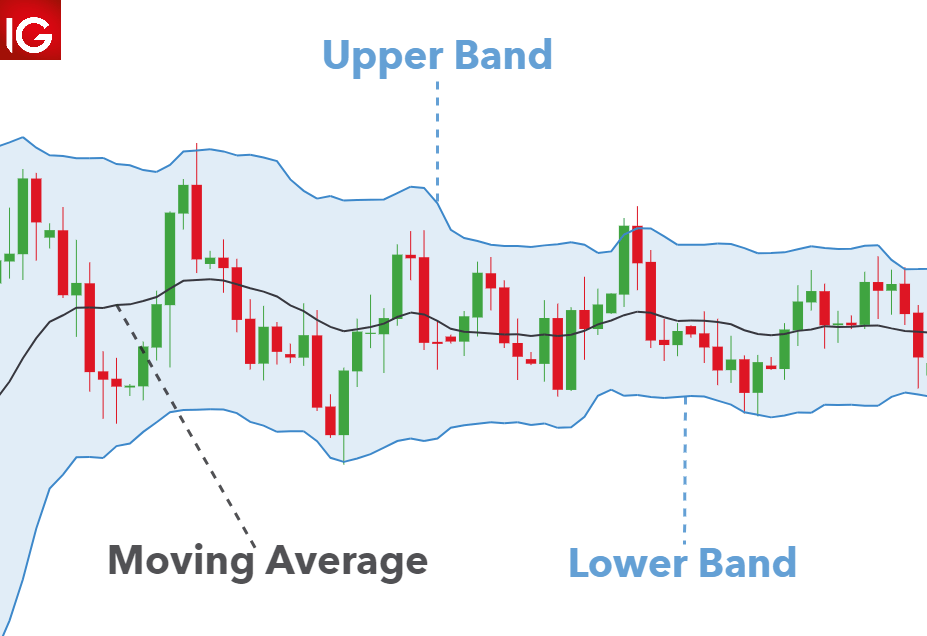
The main idea behind the BB indicator is to highlight how prices are dispersed around an average value. More specifically, it is composed of an upper band, a lower band, and a middle moving average line (also known as the middle band). The two sidelong bands react to the market price action, expanding when the volatility is high (moving away from the middle line) and contracting when volatility is low (moving towards the middle line).
The standard Bollinger Bands formula sets the middle line as a 20-day simple moving average (SMA), while the upper and lower bands are calculated based on the market volatility in relation to the SMA (which is referred to as standard deviation). The standard settings for the Bollinger Bands indicator would look like this:
  • Middle line: 20-day simple moving average (SMA)
  • Upper band: 20-day SMA + (20-day standard deviation x2)
  • Lower band: 20-day SMA – (20-day standard deviation x2)
The setting acknowledges a 20-day period and set the upper and lower bands to two standard deviations (x2) away from the middle line. This is done to ensure that at least 85% of the price data will be moving in between these two bands, but the settings may be adjusted according to different needs and trading strategies.

How to use Bollinger Bands in trading?

Although the Bollinger Bands are widely used in traditional financial markets, they may also be used for cryptocurrency trading setups. Naturally, there are various ways to use and interpret the BB indicator, but one should avoid using it as a stand-alone instrument, and it should not be considered an indicator of buying/selling opportunities. Preferably, BB should be used along with other technical analysis indicators.
With that in mind, let’s imagine how one could potentially interpret the data provided by the Bollinger Bands indicator.
If the price makes its way above the moving average and exceeds the upper Bollinger band, it is probably safe to assume that the market is overextended (overbought condition). Or else, if the price touches the upper band multiple times, it may indicate a significant resistance level.
In contrast, if the price of a certain asset drops significantly and exceeds or touches the lower band multiple times, chances are the market is either oversold or found a strong support level.
Therefore, traders may use BB (along with other TA indicators) to set their selling or buying targets. Or simply to get an overview of the previous points where the market presented overbought and oversold conditions.
In addition, the Bollinger Bands expansion and contraction may be useful when trying to predict moments of high or low volatility. The bands can either move away from the middle line as the price of the asset becomes more volatile (expansion) or move towards it as the price becomes less volatile (contraction or squeeze).
So, the Bollinger Bands are better suited for short-term trading as a way to analyze the market’s volatility and try to predict forthcoming movements. Some traders assume that when the bands are over-expanded, the current market trend may be close to a consolidation period or a trend reversal. Alternatively, when the bands get too tight, traders tend to assume that the market is getting ready to make an explosive movement.
When the market price is moving sideways, the BB tends to narrow towards the simple moving average line in the middle. Usually (but not always), low volatility and tight deviation levels precede large and explosive movements, which tend to occur as soon as the volatility picks back up.
Notably, there is a trading strategy known as the Bollinger Bands Squeeze. It consists of finding low-volatility zones highlighted by the BB contraction. The squeeze strategy is neutral and gives no clear insight into the market direction. So, traders usually combine it with other TA methods, such as support and resistance lines.

Bollinger Bands vs. Keltner Channels

Unlike Bollinger Bands, which is based on SMA and standard deviations, the modern version of the Keltner Channels (KC) indicator uses the Average True Range (ATR) to set the channel width around a 20-day EMA. Hence, the Keltner Channel formula would look like this:
  • Middle line: 20-day exponential moving average (EMA)
  • Upper band: 20-day EMA + (10-day ATR x2)
  • Lower band: 20-day EMA – (10-day ATR x2)
Typically, the Keltner Channels tend to be tighter than Bollinger Bands. So, in some cases, the KC indicator may suit better than BB for spotting trend reversals and overbought/oversold market conditions (more obvious signs). Also, the KC usually provides overbought and oversold signals earlier than BB would.
On the other hand, the Bollinger Bands tend to represent market volatility better since the expansion and contraction movements are much wider and explicit when compared to KC. Moreover, by using standard deviations, the BB indicator is less likely to provide fake signals, since its width is larger and, thus, harder to be exceeded.
Between the two, the BB indicator is the most popular. But both tools can be useful in their own way – especially for short-term trading setups. Other than that, the two may also be used together as a way to provide more reliable signals.

Liquidity Explained

Liquidity Explained

Liquidity as a term is defined as the ability to buy or sell assets in the market without causing a drastic change in the assets price. Liquidity can refer to two different areas: liquid markets and liquid assets.
A liquid market is a market that has a lot of trading activity, with many individuals willing to trade. On the other hand, a liquid asset refers to an asset that can be easily converted into cash.
But what does this mean when talking about cryptocurrencies?
As with any investment, you want to be able to sell and buy tokens quickly without a need to cut the price or wait for too long for the trade to be matched. In order for this to be possible, the market you’re trading in must be liquid. So, there must be high trading activity and the bid and ask prices must not be spread too far apart.
Let’s take an example from a seller’s point of view. Bob has 5 tokens of a certain cryptocurrency and the price for his tokens has increased in the past few days. Bob is happy and decides to quickly sell all his tokens for the current market price.
If the market is liquid, meaning that there are enough buyers that are willing to buy Bob’s tokens for the price he is asking, Bob is able to sell his assets quickly and at the price he wants. Bob’s trade doesn’t affect the market price as there is sufficient liquidity to accommodate it.
However, if Bob is asking to sell his 5 tokens at the current market price but the market is illiquid or has low liquidity, he is required to lower his asking price or wait for the market to become more liquid. This is due to the lack of buyers willing to pay the price Bob is asking. And if Bob decides to sell at a lower price, his trade is also affecting the current market price of the token.

How to tell if a market is liquid

There are three important indicators that can help determine if a market is liquid or illiquid: 24-hour trading volume, order book depth, and the bid-ask spread. the bid-ask spread is the difference between the lowest ask price and the highest bid price.
However, the order book might not always be an accurate representation due to factors like stop-limit orders and iceberg orders, which are not always visible in the order book.
Liquidity is extremely important when considering your trades. It is one key factor for easily entering or exiting a particular market.

Moving Averages Explained

Moving Averages Explained

Technical analysis (TA) is nothing new in the world of trading and investing. From traditional portfolios to cryptocurrencies like Bitcoin and Ethereum, the use of TA indicators has a simple goal: use existing data to make more informed decisions that will likely lead to desired outcomes. As markets grow increasingly more complicated, the last decades have produced hundreds of different types of TA indicators, but few have seen the popularity and consistent usage of moving averages (MA).
Although there are different variations of moving averages, their underlying purpose is to drive clarity in trading charts. This is done by smoothing out the graphs to create an easily decipherable trend indicator. Because these moving averages rely on past data, they are considered to be lagging or trend following indicators. Regardless, they still have great power to cut through the noise and help determine where a market may be heading.

Different types of moving averages

There are various different types of moving averages that can be utilized by traders not only in day trading and swing trading but also in longer-term setups. Despite the various types, the MAs are most commonly broken down into two separate categories: simple moving averages (SMA) and exponential moving averages (EMA). Depending on the market and desired outcome, traders can choose which indicator will most likely benefit their setup.

The simple moving average

The SMA takes data from a set period of time and produces the average price of that security for the data set. The difference between an SMA and a basic average of the past prices is that with SMA, as soon as a new data set is entered, the oldest data set is disregarded. So if the simple moving average calculates the mean based on 10 days worth of data, the entire data set is constantly being updated to only include the last 10 days.
It’s important to note that all data inputs in an SMA are weighted equally, regardless of how recently they were inputted. Traders who believe that there’s more relevance to the newest data available often state that the equal weighting of the SMA is detrimental to the technical analysis. The exponential moving average (EMA) was created to address this problem.

The exponential moving average

EMAs are similar to SMAs in that they provide technical analysis based on past price fluctuations. However, the equation is a bit more complicated because an EMA assigns more weight and value to the most recent price inputs. Although both averages have value and are widely used, the EMA is more responsive to sudden price fluctuations and reversals.
Because EMAs are more likely to project price reversals faster than SMAs, they are often especially favored by traders who are engaged in short-term trading. It is important for a trader or investor to choose the type of moving average according to his personal strategies and goals, adjusting the settings accordingly.

How to use moving averages

Because MAs utilize past prices instead of current prices, they have a certain period of lag. The more expansive the data set is, the larger the lag will be. For example, a moving average that analyzes the past 100 days will respond more slowly to new information than an MA that only considers the past 10 days. That’s simply because a new entry into a larger dataset will have a smaller effect on the overall numbers.
Both can be advantageous depending on the trading setup. Larger data sets benefit long-term investors because they are less likely to be greatly altered due to one or two large fluctuations. Short-term traders often favor a smaller data set that allows for more reactionary trading.
Within traditional markets, MAs of 50, 100 and 200 days are the most commonly used. The 50-day and the 200-day moving averages are closely watched by stock traders and any breaks above or below these lines are usually regarded as important trading signals, especially when they are followed by crossovers. The same applies to cryptocurrency trading but due to its 24/7 volatile markets, the MA settings and trading strategy may vary according to the trader profile.

Crossover signals

Naturally, a rising MA suggests an upward trend and a falling MA indicates a downtrend. However, a moving average alone is not a really reliable and strong indicator. Therefore, MAs are constantly used in combination to spot bullish and bearish crossover signals.
A crossover signal is created when two different MAs crossover in a chart. A bullish crossover (also known as a golden cross) happens when the short-term MA crosses above a long-term one, suggesting the start of an upward trend. In contrast, a bearish crossover (or death cross) happens when a short-term MA crosses below a long-term moving average, which indicates the beginning of a downtrend. 

Other factors worth considering

The examples so far have all been in terms of days, but that’s not a necessary requirement when analyzing MAs. Those engaged in day trading may be much more interested in how an asset has performed over the past two or three hours, not two or three months. Different time frames can all be plugged into the equations used to calculate moving averages, and as long as those time frames are consistent with the trading strategy, the data can be useful.
One major downside of MAs is their lag time. Since MAs are lagging indicators that consider previous price action, the signals are often too late. For instance, a bullish crossover may suggest a buy, but it may only happen after a significant rise in price. 
This means that even if the uptrend continues, potential profit may have been lost in that period between the rise in price and the crossover signal. Or even worse, a false golden cross signal may lead a trader to buy the local top just before a price drop. These fake buy signals are usually referred to as a bull trap.

Closing thoughts

Moving Averages are powerful TA indicators and one of the most widely used. The ability to analyze market trends in a data-driven manner provides great insight into how a market is performing. Keep in mind, however, that MAs and crossover signals should not be used alone and it is always safer to combine different TA indicators in order to avoid fake signals.

What Is Inflation?

By this means the government may secretly and unobserved, confiscate the wealth of the people, and not one man in a million will detect the theft.
– John Maynard Keynes on inflation of monetary supply. The Economic Consequences of the Peace (1920).
Inflation is the increase in the price of goods and services in an economy, over a set period of time. For that reason, inflation is also defined as the reduction of the purchasing power of a given currency. There are several conditions that define price inflation.
First, the rise in prices has to be sustained and not just a sporadic event. While prices may go up suddenly on an item, this may not necessarily be inflation. These are called “relative-price changes” and often occur due to a problem with the supply and demand of a particular good. Once the supply increases to meet demand, the price will stabilize. On the other hand, during inflation, the rise in prices continues without stabilizing.
Second, inflation involves a general increase in the prices of goods and services. While “relative-price change” usually means just one or two goods have increased in price, inflation refers to an increase in costs of nearly all items in the economy.
Third, inflation is a long-term phenomenon. The general increase in prices continues for an extended period of time. Most modern nations perform annual measurements of inflation rates, and studies reveal that inflation often stretches over several years.

How does inflation work?

Causes of inflation

Economists have identified two basic causes of inflation. First, a rapid increase in the amount of actual currency in circulation (supply). For instance, when European conquistadors subjugated the western hemisphere in the 15th century, gold and silver bullion flooded into Europe and caused inflation.
Second, inflation can occur due to a supply shortage in a specific good that is in high demand. This can then spark a rise in the price of that good, which may ripple through the rest of the economy. The result can be a general rise in prices across nearly all goods and services.

Measuring inflation

There are many different approaches to how inflation is measured. The usual method is to measure the prices of the most relevant goods and services. To perform such a measurement, government agencies may conduct, for example, household surveys that identify the commonly purchased items within a community or country. The prices of these items are then tracked over time and used as a base for the calculation.

Inflation vs. deflation

Deflation is when there is a general decline in prices over a set period. Though inflation is often a threat to a nation’s economy, deflation may also be dangerous.
First, deflation tends to slow down economic activity. As prices fall, consumers develop the habit of delaying purchases until prices are lower. Second, deflation can then cause businesses to reduce investing in improved production due to lower consumer demand. Finally, this translates into less demand for borrowing money, which leads to lower interest rates. While lower interest rates may help consumers who take out a mortgage or loan, it hurts the ones who live off of the interest earned from savings accounts.
Followed by the Stock Market Crash of 1929, the Great Depression is one notable example of deflation. It is considered the largest and longest economic depression in modern world history. The economic contraction caused the money supply to reduce and started a downward economic spiral. The US unemployment rate raised from 3.2% to roughly 25% in 4 years, decreasing the demands for goods and resulting in even more unemployment.
Economists term this sequence a deflationary spiral because one negative economic event leads to another. Often some type of financial crisis sparks the cycle by reducing demand for goods and services, which slows down production. This reduces wages and income, which in turn further curtails demand. The slowdown causes prices to drop. Once a deflationary spiral begins, the problems it creates can easily continue the downturn. Financial experts consider deflationary spirals to be a great threat to a nation’s economy.

Inflation in Venezuela

A clear example of the impact of inflation is found in Venezuela. The South American country has seen its economy crumble under inflation over the last years. Socialist policies, widespread corruption, and falling oil prices are probably some of the major causes of Venezuela’s hyperinflation.

Why inflation matters?

Inflation is an important issue as it can have both positive and negative effects on a nation’s economy and a consumer’s personal finances.

The positive aspects of inflation

Though inflation is often very harmful, it can have some positive benefits. First, inflation can stimulate a nation’s economy. As more money circulates, there is more money to spend, which creates more demand. This spurs production, reduces unemployment, and puts more money into the economy as a whole.
Second, inflation protects against an economic danger called the “Paradox of Thrift”. This is a term coined by John Maynard Keynes, a famous 20th-century economist. It refers to the tendency of consumers to delay buying goods when prices are falling during deflation. As you can see, inflation works the opposite way of deflation – it prompts consumers to buy goods and services quickly before prices increase more.

The negative aspects of inflation

Though economists and government officials are rightfully concerned with inflation, it also matters for common citizens for several reasons. It hurts the most vulnerable people in a nation – the poor and the elderly and also decreases the real income of the working class. Third, it causes interest rates to go up. Finally, inflation reduces the value of savings. People who have spent years saving money to provide for education or retirement will see the buying power of that money greatly reduced.

Cryptocurrencies and inflation

While national governments try to control inflation, Bitcoin is seen by many as a good hedge against the ravages of inflation. This is due to the fact that Bitcoin has a fixed total supply of 21 million coins. Despite some controversies, many believe that this makes Bitcoin a deflationary currency, and therefore, resistant to inflation. For this reason, many Venezuelans have begun using Bitcoin or other cryptocurrencies to cope with the nation’s hyperinflation.

Bitcoin, The 2008 Financial Crisis Explained

Past and present

In 2008, the financial crisis shook the global economy. Now ten years later, people are wondering how the rules have changed, and more importantly, how this type of economic crisis can be avoided in the future.
What began as a crisis in regards to the subprime mortgage market, later developed into a large-scale, global financial crisis and recession. From massive bailouts to the resulting economic downturn, many are now questioning the stability and transparency of the global banking systems they previously trusted.

What happened during the financial crisis?

Referred to as the worst economic disaster since the Great Depression, the 2008 financial crisis devastated the world economy. This resulted in what’s known as the Great Recession, which led to falling housing prices and sharp increases in unemployment. The associated repercussions were enormous, and are still influencing financial systems today.
In the US, more than eight million citizens lost their jobs, approximately 2.5 million businesses were devastated, and close to four million homes were foreclosed in less than two years. From food insecurity to income inequality, many have lost faith in the system.
The recession officially ended in 2009, but many continued to suffer long after it, especially in the US. The unemployment rate reached 10% in 2009 and was only recovered to pre-crisis levels in 2016.

What caused the Great Recession?

In terms of the cause, numerous factors were to blame. The “perfect storm” was brewing and once it reached its breaking point, a financial crisis ensued. Financial institutions were giving out high-risk loans (mainly mortgages) that eventually resulted in a massive taxpayer-financed bailout.
The true cause of the 2008 financial crisis is highly complex, but it was America’s housing market that initiated a chain reaction – one that would expose cracks in the financial system. This was followed by the bankruptcy of the Lehman Brothers firm which had a crippling effect on the American and European economy. 
In turn, the episode made the public aware of the banks’ potential shortcomings. It also caused significant disruptions around the world, based on how the global economy is interconnected.

Why does it matter today?

Although it has been a decade since the financial crisis hit, there are still concerns. The effects of this recession are still alive, and the global economic recovery has been fairly weak in comparison to historical standards. High-risk loans are being offered once again, and although default rates are low today, that could change very quickly.
Regulators insist that the global financial system has been altered since 2008 and that safety measures have been considerably enhanced. For this reason, many believe that the global financial system is stronger today than it was a decade ago.
On the other hand, some are still wondering: could this type of economic crisis happen again? The short answer is yes, anything is possible. Despite the many changes that were made and the new rules that were enforced, there are fundamental problems that remain.
Noteworthy, the 2008 financial crisis reminds us that policy matters. The events that took place in 2008 were essentially caused by the decisions that regulators, politicians, and policymakers made years prior. From poorly controlled regulatory bodies to the impact of corporate culture, the Great Recession is anything but “in the past.”

The development of Bitcoin and other cryptocurrencies

While the rise of a financial crisis in 2008 highlighted some of the risks associated with the traditional banking system, 2008 was also the birth year of Bitcoin – the first cryptocurrency to be created.
In contrast to fiat currencies, such as the US dollar or British pound, Bitcoin and other cryptocurrencies are decentralized, which means they are not controlled by a national government or central bank. Instead, the creation of new coins is determined by a predefined set of rules (protocol).
The Bitcoin protocol and its underlying Proof of Work consensus algorithm ensure that the issuance of new cryptocurrency units follows a regular schedule. More specifically, the generation of new coins is reliant on a process known as mining. The miners are not only responsible for introducing new coins into the system but also for securing the network by verifying and validating transactions.
In addition, the protocol establishes a fixed max supply that guarantees there will only ever be a total of 21 million Bitcoins in the world. This means that there are no surprises when it comes to the current and future supply of Bitcoin. Moreover, the Bitcoin source code is open-source, so anyone is able to not only check it but also to contribute and participate in its development.

Closing thoughts

Although it has been a decade since the 2008 financial crisis, people have not forgotten how fragile the international banking system really is. We cannot be totally sure, but this is probably one of the reasons that led to the creation of a decentralized digital currency like Bitcoin.
Cryptocurrencies still have a long way to go, but they definitely represent a viable alternative for the traditional fiat system. Such an alternative economic network may bring financial independence where there is none, and certainly has the potential to create a better society going forward.

Teknikal Prediksi Bitcoin Harian Hari ini, Bitcoin Indonesia

prediksi bitcoin hari ini
Analisa Bitcoin Indonesia, prediksi bitcoin harian dan mingguan, teknikal bitcoin indonesia, Kabar berita bitcoin indonesia, signal gratis trading bitcoin, analisa teknikal altcoin bitcoin indonesia, belajar trading bitcoin, Trader bitcoin Indonesia, ITCrypto.
Jumpa lagi di artikel tentang prediksi bitcoin atau kabar berita bitcoin di indonesia, Khususnya untuk para teman-teman kami di group telegram @trader_ITC, Hari ini kami akan membahas tentang trend bitcoin dan Teknikal prediksi harga bitcoin. Ohya sekarang kami menerima tulisan Anda, Buat artikel yang ingin Anda Post di blog ini, tentunya membahas seputar Blockchain dan Cryptocurrency, Anda juga bisa kirim Artikel seperti Airdrop dll, dan dikirim ke telegram kami Trader Indonesia.

Prediksi Bitcoin Hari Ini

Prediksi Bitcoin Harianterhitung zona UTC, karena biasanya kami menggunakan zona waktu UTC untuk memprediksi Harga Bitcoin.
Berikut adalah analisa teknikal prediksi bitcoinkami untuk hari ini, silakan lihat gambar dan siapkan sesaji untuk menemani obrolan kita 😀 , bagi anda yang kurang setuju dan atau ingin konsultasi, bertanya silakan di kolom komentar.

Kami menggunakan chart 1h dan memiliki rentan waktu 1 hari untuk bertahan, terkadang juga bisa di gunakan memprediksi Trend bitcoin 1 minggu, Jangan salah faham tentang Trend dan Harga.
prediksi bitcoin hari ini
Resistance Bitcoin. Garis warna Ungukami gunakan sebagai Resistance Bitcoin hari ini, Prediksi ini kami tulis disaat harga bitcoin masih $6714 Usdt. silakan lihat harga gambar diatas, ohya menurut kami sebagai seorang trader kita harus paham istilah resistance, untuk berlatih memahami resistance silakan masuk disini Belajar Support and Resistance Bitcoin.
Menurut kami Resistance trend bitcoin chart 1 jam tertahan oleh chart Bitcoin 4 Jam, maka dari itu kami lebih baik memilih menyarankan hati” jika bitcoin turun hari ini. berikut adalah chart bitcoin 4 jam.


Walaupun harga bitcoin 1 jam tertahan oleh 4 jam, bisa saja perlawanan bitcoin 1 jam menuai resistance, akan tetapi kami lebih utamakan 4 jam jika membuat prediksi 1 hari, dan Patokan ketika bitcoin ke level support atau resistance silakan lihat catatan di bawah ini.
  • Support Bitcoin 1h : $6555 – $6466
  • Support Bitcoin 4h : $6550 – $6400
  • Support Bitcoin 1d : $6200
  • Resistance Bitcoin : $6800 – $7000

Penutup

Jika bitcoin sekarang turun jangan panik, karena bila 1 jam melawan 4 jam maka harga bitcoin 1 hari ini bisa stagnan di $6600, Jangan lupa gabung di group telegram kami untuk mendapatkan pembaruan dan arahan dari artikel diatas.