Arsip Tag: margin

Binance Explanation, Totorials binance margin trading guide 2020

How to open a Margin Trading account on Binance

After logging in to your Binance account, move your mouse to the top right corner to and hover over your profile icon. This will be different for everyone and will show the first two characters of your email address. When the dropdown opens, click on your email to go to your account dashboard.


If you don’t know what margin trading is, we recommend reading our article “What is Margin Trading” before opening your margin trading account on Binance.


Binance Margin Trading Guide

You will now be on your account dashboard. You can see your account balances from this page. Below “Balance Details” click on “Margin” to begin the process of opening your margin trading account on Binance. You will need to have completed identity verification (KYC) and make sure your country is not in the blacklist. It is also mandatory that you enable 2FA.

Binance Margin Trading Guide

Next, you will see a reminder about the risks of margin trading. Please read it and, if you are willing to proceed, click on the “Open margin account” button.

Binance Margin Trading Guide

Please take the time to read the margin account agreement carefully. If you understand and agree to the Terms and Conditions, tick the box and click “I understand.”

Binance Margin Trading Guide

How to transfer funds

After activating your margin account, you will be able to transfer funds from your regular Binance Wallet to your Margin Trading Wallet. To do so, click on the “Wallet” tab, select “Margin” and click on the “Transfer” button on the right side of the page.
Binance Margin Trading Guide

Next, select which coin you wish to transfer. In this case, we will use the BNB.

Binance Margin Trading Guide

Input the amount you want to transfer from your Exchange Wallet to your Margin Wallet and click “Confirm transfer.”
Binance Margin Trading Guide

How to borrow funds

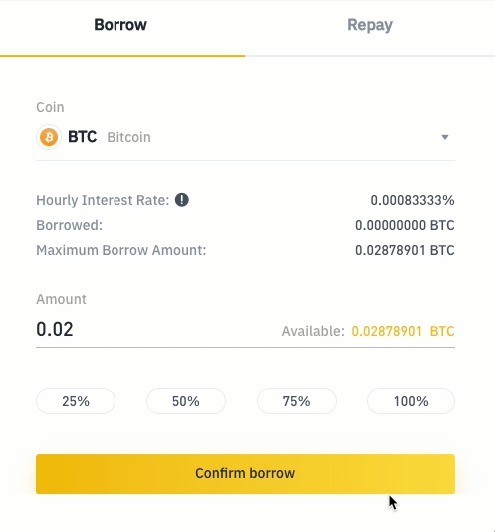
After transferring BNB coins to your Margin Wallet, you will be able to use those coins as collateral to borrow funds. Your Margin Wallet balance determines the amount of funds you can borrow, following a fixed rate of 5:1 (5x). So if you have 1 BTC, you can borrow 4 more. In this example, we will borrow 0.02 BTC.

Binance Margin Trading Guide

After selecting the coin you wish to borrow and the amount, click “Confirm borrow.”
Binance Margin Trading Guide

Next, your margin account will be credited with the Bitcoin you borrowed. You will now be able to trade the borrowed funds while having a debt of 0.02 BTC plus the interest rate. The interest rate is updated every 1 hour. You can check the currently available pairs as well as their rates on the Margin Fee page.
You can check your current margin account status by going to your “Wallet Balance” page and selecting the “Margin” tab.

Binance Margin Trading Guide

The Margin Level

On the right side of the screen, you will see your margin level, which gives you a risk level according to the borrowed funds (Total Debt) and to the funds you hold as collateral on your margin account (Account Equity).

Binance Margin Trading Guide

The risk level changes according to the market movements, so if the prices move against your prediction, your assets can be liquidated. Note that in case you are liquidated, you will be charged extra fees.
The formula to calculate the margin level is:
Margin Level = Total Asset Value / (Total Borrowed + Total Accrued Interest)
If your margin level drops to 1.3, you will receive a Margin Call, which is a reminder that you should either increase your collateral (by depositing more funds) or reduce your loan (by repaying what you’ve borrowed).
If your margin level drops to 1.1, your assets will be automatically liquidated, meaning that Binance will sell your funds at market price to repay the loan.
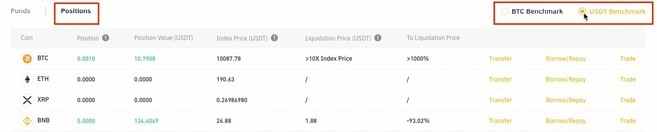
Click on “Positions” to check detailed information about your current positions. If you prefer to see the values in USDT, select “USDT Benchmark” on the right side.
Binance Margin Trading Guide

How to trade on margin

If you wish to use your borrowed funds to trade, you can go to the Exchange page, select the “Margin” tab, and trade normally using LimitMarketStop-Limit, and OCO orders.

Binance Margin Trading Guide

How to repay your debt

To repay your debt, click on “Borrow/Repay” button and select the “Repay” tab.

Binance Margin Trading Guide

The total amount to be paid is the sum of the total borrowed plus the interest rates. Make sure you have the required balance before proceeding.
When you are ready, select the coin and amount you wish to repay, and click “Confirm repayment.” Note that you can only use the same cryptocurrency to make the repayment.

Binance Margin Trading Guide

The switch button

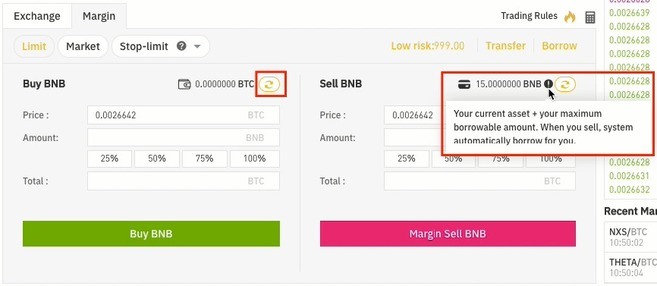
You will notice that the margin interface has a switch button next to your balances. This button allows you to switch between asset mode (normal orders) and margin mode (margin orders).
For example, if you hold 5 BNB in your Margin account, you can sell a total of 15 BNB.
Note that now you have the “Margin Sell BNB” button rather than the regular “Sell BNB”.
Binance Margin Trading Guide

So, if you decide to “Margin Sell” 7 BNB, the system will automatically borrow 2 BNB for you (remember that your actual balance is 5 BNB).

Binance Margin Trading Guide

After clicking “Margin Sell BNB,” you see the following confirmation message:

Binance Margin Trading Guide

So, the Switch button allows you to quickly borrow funds when opening new positions. However, you have to repay the borrowed funds manually afterward.

Moving funds back

If you wish to move your funds back from the Margin Wallet to your regular Binance Wallet, click on “Transfer” and use the button in-between the two wallets to change the direction of the transfer. Next, select the coin and amount and click “Confirm transfer.”

Binance Margin Trading Guide
You can move your funds freely from one wallet to another, without any fees. But note that if you currently have assets borrowed, your risk level will increase as the funds of your Margin Wallet decreases. If your Risk Level gets too high, there is a chance of your assets being liquidated. So make sure you understand how margin trading works before using it.

An example

Alice believes the price of BNB will go up, so she wants to open a leveraged long position on BNB. To do so, she first transfers funds to her Margin Wallet and then borrows BTC. Next, Alice uses the borrowed BTC to buy BNB.
If the price of BNB goes up as Alice expected, she can sell her assets and repay the borrowed BTC along with the corresponding interest. Any leftover for that trade will represent her profits.
However, margin trading can amplify both the gains and the losses. So if the market moves against Alice’s position, she will have bigger losses.

What Is Margin Trading?

What Is Margin Trading?

Margin trading is a method of trading assets using funds provided by a third party. When compared to regular trading accounts, margin accounts allow traders to access greater sums of capital, allowing them to leverage their positions. Essentially, margin trading amplifies trading results so that traders are able to realize larger profits on successful trades. 
This ability to expand trading results makes margin trading especially popular in low-volatility markets, particularly the international Forex market. Still, margin trading is also used in stock, commodity, and cryptocurrency markets.
In traditional markets, the borrowed funds are usually provided by an investment broker. In cryptocurrency trading, however, funds are often provided by other traders, who earn interest based on market demand for margin funds. Although less common, some cryptocurrency exchanges also provide margin funds to their users.
What Is Margin Trading?

How does margin trading work?

When a margin trade is initiated, the trader will be required to commit a percentage of the total order value. This initial investment is known as the margin, and it is closely related to the concept of leverage. 
In other words, margin trading accounts are used to create leveraged trading, and the leverage describes the ratio of borrowed funds to the margin. For example, to open a $100,000 trade at a leverage of 10:1, a trader would need to commit $10,000 of their capital.
Naturally, different trading platforms and markets offer a distinct set of rules and leverage rates. In the stock market, for example, 2:1 is a typical ratio, while futures contracts are often traded at a 15:1 leverage. In regards to Forex brokerages, margin trades are frequently leveraged at a 50:1 ratio, but 100:1 and 200:1 are also used in some cases. 
When it comes to cryptocurrency markets, the ratios are typically ranging from 2:1 to 100:1, and the trading community often uses the ‘x’ terminology (2x, 5x, 10x, 50x, and so forth).
Margin trading can be used to open both long and short positions. A long position reflects an assumption that the price of the asset will go up, while a short position reflects the opposite. While the margin position is open, the trader’s assets act as collateral for the borrowed funds. 
This is critical for traders to understand, as most brokerages reserve the right to force the sale of these assets in case the market moves against their position (above or below a certain threshold).
For instance, if a trader opens a long leveraged position, they could be margin called when the price drops significantly. A margin call occurs when a trader is required to deposit more funds into their margin account in order to reach the minimum margin trading requirements. If the trader fails to do so, their holdings are automatically liquidated to cover their losses. 
Typically, this occurs when the total value of all of the equities in a margin account, also known as the liquidation margin, drops below the total margin requirements of that particular exchange or broker.

Advantages and disadvantages

The most obvious advantage of margin trading is the fact that it can result in larger profits due to the greater relative value of the trading positions. Other than that, margin trading can be useful for diversification, as traders can open several positions with relatively small amounts of investment capital. Finally, having a margin account may make it easier for traders to open positions quickly without having to shift large sums of money to their accounts.
For all its upsides, margin trading does have the obvious disadvantage of increasing losses in the same way that it can increase gains. Unlike the regular spot trading, margin trading introduces the possibility of losses that exceed a trader’s initial investment and, as such, is considered a high-risk trading method. Depending on the amount of leverage involved in a trade, even a small drop in the market price may cause substantial losses for traders. For this reason, it’s important that investors who decide to utilize margin trading employ proper risk management strategies and make use of risk mitigation tools, such as stop-limit orders.

Margin trading in cryptocurrency markets

Trading on margin is inherently riskier than regular trading, but when it comes to cryptocurrencies, the risks are even higher. Owing to the high levels of volatility, typical to these markets, cryptocurrency margin traders should be especially careful. While hedging and risk management strategies may come handy, margin trading is certainly not suitable for beginners. 
Being able to analyze charts, identify trends, and determine entry and exit points won’t eliminate the risks involved with margin trading, but it may help to better anticipate risks and trade more effectively. So before leveraging their cryptocurrency trades, users are recommended first to develop a keen understanding of technical analysis and to acquire an extensive spot trading experience.

Margin funding

For investors who do not have the risk tolerance to engage in margin trading themselves, there is another way to profit from the leveraged trading methods. Some trading platforms and cryptocurrency exchanges offer a feature known as margin funding, where users can commit their money to fund the margin trades of other users.
Usually, the process follows specific terms and yields dynamic interest rates. If a trader accepts the terms and takes the offer, the funds’ provider is entitled to repayment of the loan with the agreed upon interest. 
Although the mechanisms may differ from exchange to exchange, the risks of providing margin funds are relatively low, owing to the fact that leveraged positions can be forcibly liquidated to prevent excessive losses. Still, margin funding requires users to keep their funds in the exchange wallet. So, it is important to consider the risks involved and to understand how the feature works on their exchange of choice.
Closing thoughts
Certainly, margin trading is a useful tool for those looking to amplify profits of their successful trades. If used properly, the leveraged trading provided by margin accounts can aid in both profitability and portfolio diversification.
As mentioned, however, this method of trading can also amplify losses and involves much higher risks. So, it should only be used by highly skilled traders. As it relates to cryptocurrency, margin trading should be approached even more carefully due to the high levels of market volatility.